
'Clearly, from the Indian viewpoint, the US retrenchment from Asia cannot be happening as good news.' 'The abandonment of the US' pivot to Asia exposes the US-Indian partnership to be a mere transactional relationship,' says Ambassador M K Bhadrakumar

Aziz Haniffa, who has covered every Indian Prime Minister's visit to the US since Rajiv Gandhi in 1985, gives us a peek into what's happening in Washington, DC on the eve of the Modi-Trump summit.

Both the Greek and Iranian deals are extremely imperfect and fraught with uncertainty, says Claude Smadja.

'You will see more and more people working independently -- starting beauty parlours, driving cars, etc.' This is what we call the gig economy.' 'The same people who have been laid off in India or are unable to get visas to work in the US may be part of this gig economy.' 'India needs billions of jobs, and it can only be created by self-employment or the gig economy.'

The central government has drafted a law to restrict wombs for hire, and there is much to be said on all sides.

Iraq is on the verge of collapsing and foreign military intervention is inevitable. But for those who follow the developments in Iraq and the Middle-East will understand the current situation is nothing but a culmination of US and western policies toward the region, says Dr Waiel Awwad

'Pakistan's negativism should be seen as the reason for India losing interest in SAARC.'

When it comes to celebrating William Shakespeare, can India be far behind?
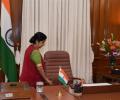
Sushma Swaraj, like Clinton, has a strong political base in her own party and is likely to have her imprint on foreign policy, says Ambassador T P Sreenivasan.

His sartorial taste is not something he acquired suddenly as the chief minister of the prime minister. His "god-given" dress sense is like his politics: inventive, imaginative if slightly unconventional, often loud. It goes well with his oratory, robust persona and penchant for coining terms, says Mahendra Ved.
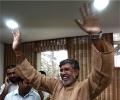
'Today, when Kailash Satyarthi is being honoured with the most prestigious global award, reports appear to the effect that many millions of Indian children are in 'slavery'. This is hardly the reputation that India should have when we are basking in the glory of 'Mangalyan',' says T P Sreenivasan.

'If the Iran nuke deal holds, Iran becomes a gateway to Afghanistan, and a better one than Pakistan because the route is not so mountainous. Correspondingly, I imagine Pakistan's value to the US will fall,' says Rajeev Srinivasan.

All those of us who care about books should welcome the appointment, as head of the Indian Council of Historical Research, of Yellapragada Sudarshan Rao. This is not because Rao has so far distinguished himself as a writer about "history and tourism management", which is the department of Kakatiya University in Warangal he headed before retiring to head an Rashtriya Swayamsevak Sangh-backed project to "write history from a nationalist perspective and popularise Sanskrit", two aims which naturally go together for the RSS.

'There is tension between the zones all the time.'
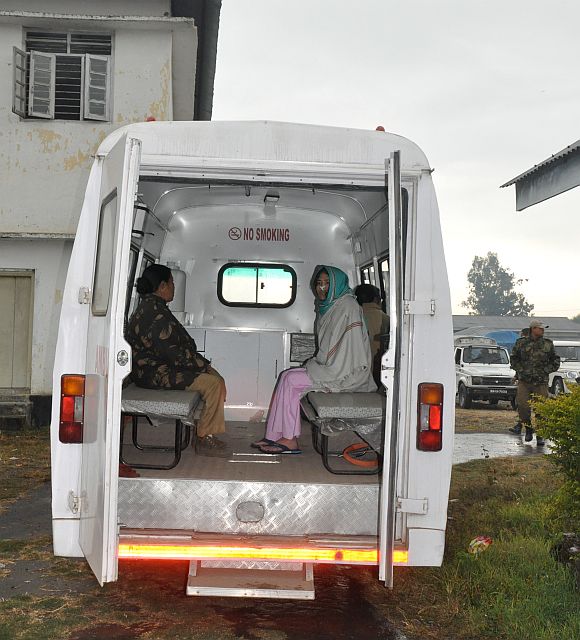
On the occasion of her breaking the world's longest hunger strike, Rediff.com reproduces this 2011 feature on the activist and her life.

Finance Minister Arun Jaitley appealed to parties to rise above partisan considerations to support it.

'The question now is how long the exercise in perfection he created will last once his influence isn't there any longer,' says Sunanda K Datta-Ray.
'The government must keep bad news out of the newspapers. If you have news about a fight everyday, it is not a climate where investment takes place.'

An Olympic campaign saved by the fortitude of three women, a cricket team that rediscovered itself under a bold and zealous Virat Kohli -- Indian sports in 2016 was a dramatic mix of highs and lows wherein athletes mostly raised the bar but administrators found new ways to embarrass the country.

'A few months ago, everybody was saying, "Why isn't Vijender taking part in the Olympics?"' 'This is not like going to Haryana or Delhi that you just take a ticket and reach there.' 'Going to the Olympics is not easy'
TCS still ace in the pack
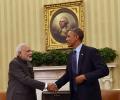
Narendra Modi would have done well to take a few more months before he agreed to receive or call on heads of countries like Japan, China, and the US. The prime minister is to settle down in his job and it was too soon for him to have full awareness of the nuances of intricate international issues, says B S Raghavan.

Arvind Subramanian talks about US and China's power play and where India figures in these dynamics.
'Why not ask for a change of leadership in Qatar, Bahrain or Saudi Arabia? Is there a constitution in Saudi Arabia? Are there elections in Saudi Arabia? Why no talk of democracy in these countries?' 'America said change the leader now, but is now ignoring the feelings of the Syrian moderate majority. Is that democracy,' asks H E Dr Riad Abbas, Syrian ambassador to India, in an interview to Cleo Paskal.

'It is important to note that American officials were trying their best to use the Taliban for their oil games till December 1997 when Mullah Ghous was invited to America. State Department officials did not show any interest in capturing or killing Osama bin Laden even at that time.'

Away from the cricket field, it was a year in which Sania Mirza was unarguably the biggest success story with her staggering 10 titles on the Tour -- two of them Grand Slams.

'Modi as the PM of the country has to take everybody on board and deliver on good governance. That is his responsibility. In that talking alone won't help, he's working.' Commerce Minister Dr Nirmala Sitharaman tells Sheela Bhatt/Rediff.com how the Modi government plans to change India.

Few readers will remember the socialist utopia of Indira Gandhi when food queues were the norm even for the middle class and tankers supplied water at odd hours of the night twice a week. Is that what you are trying to return us to, dear Congress, asks Jaideep Prabhu

It is easy to foretell that negotiating a comprehensive and final agreement on the Iran nuclear issue is by no means an easy task. It involves hard negotiations, but the hardest step has been taken, says Ambassador M K Bhadrakumar, who was among the first group of foreigners to visit the the top-secret Arak plant hidden behind barren mountains south of Tehran.

President Pranab Mukherjee on Monday addressed the first joint sitting of Parliament as mandatorily required under the Constitution after the general elections. The address is the political, economic and foreign policy road map of the Narendra Modi government and covers virtually all crucial areas.

'The real test will be in defence-related deals, for instance the Javelin anti-tank missile: Is the US willing to co-develop something with India, on terms that will support the 'Make in India' initiative? Is there defence technology transfer? Or will it dump old junk on India?' asks Rajeev Srinivasan.
 © 2026 Rediff.com - Advertise with us - Disclaimer - Privacy Policy - Sitemap - Feedback - About us - Terms of use - Grievances